Research
I am an observational astronomer studying how galaxies form and evolve, with a particular interest in how supermassive black holes influence this evolution through Active Galactic Nuclei (AGN) feedback. I use imaging and spectroscopic observations from both ground-based and space-based telescopes, covering galaxies across a wide range of cosmic time, and interpret these data using semi-empirical models and cosmological hydrodynamical simulations. I am an active member of several international collaborations, including BASS, SUPER,
GOALS, COSMOS-Web,
COSMOS-3D, and QFeedS.
Below, I highlight some of the projects I have been/am working on:
Outflows in galaxies hosting Supermassive Black holes
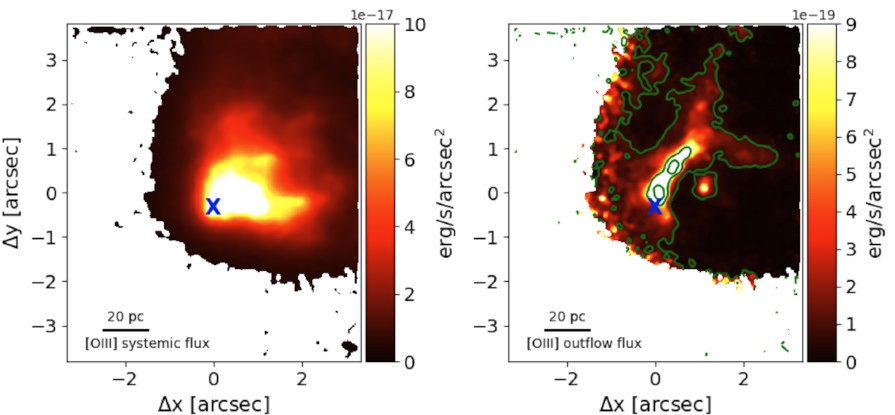
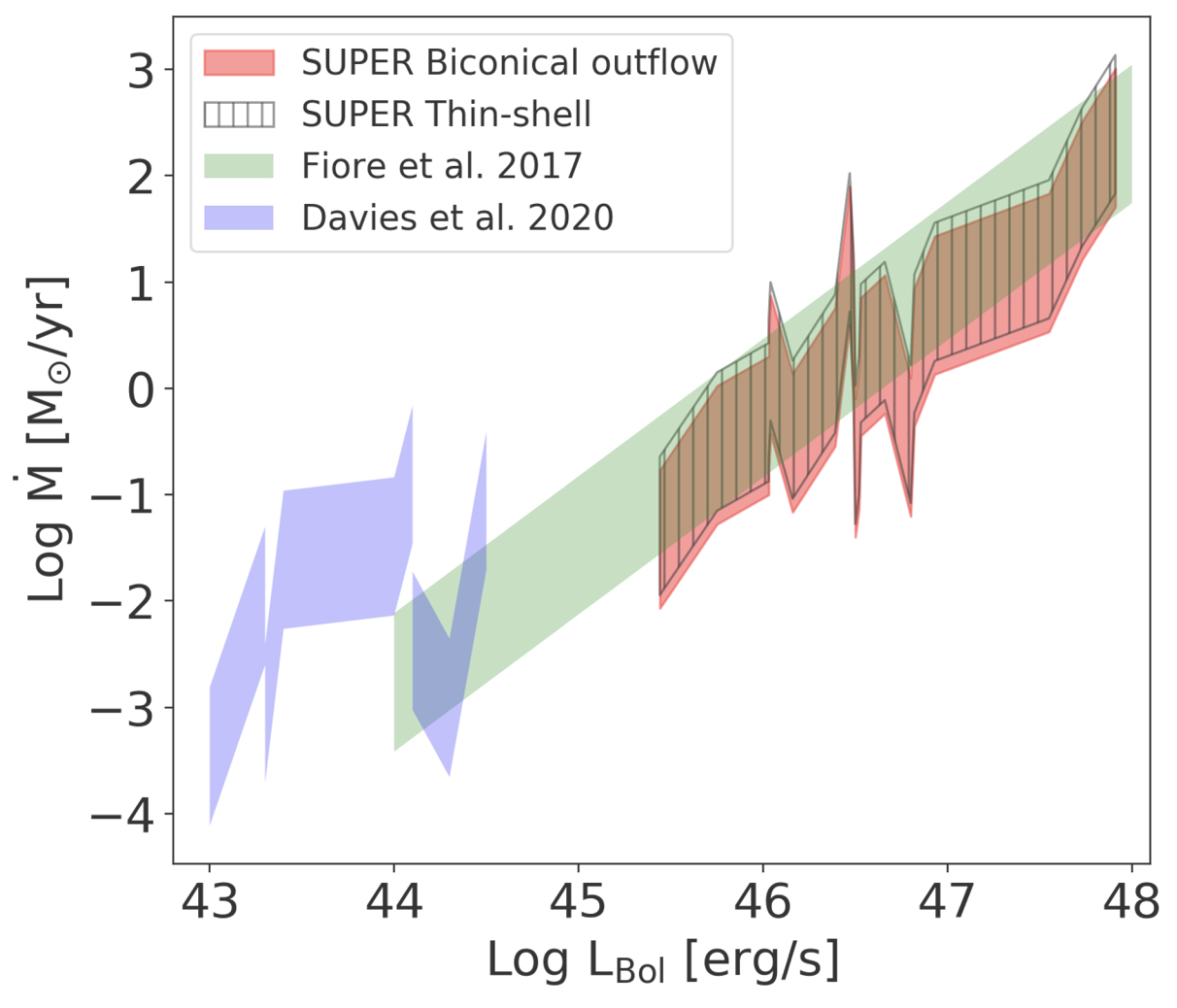
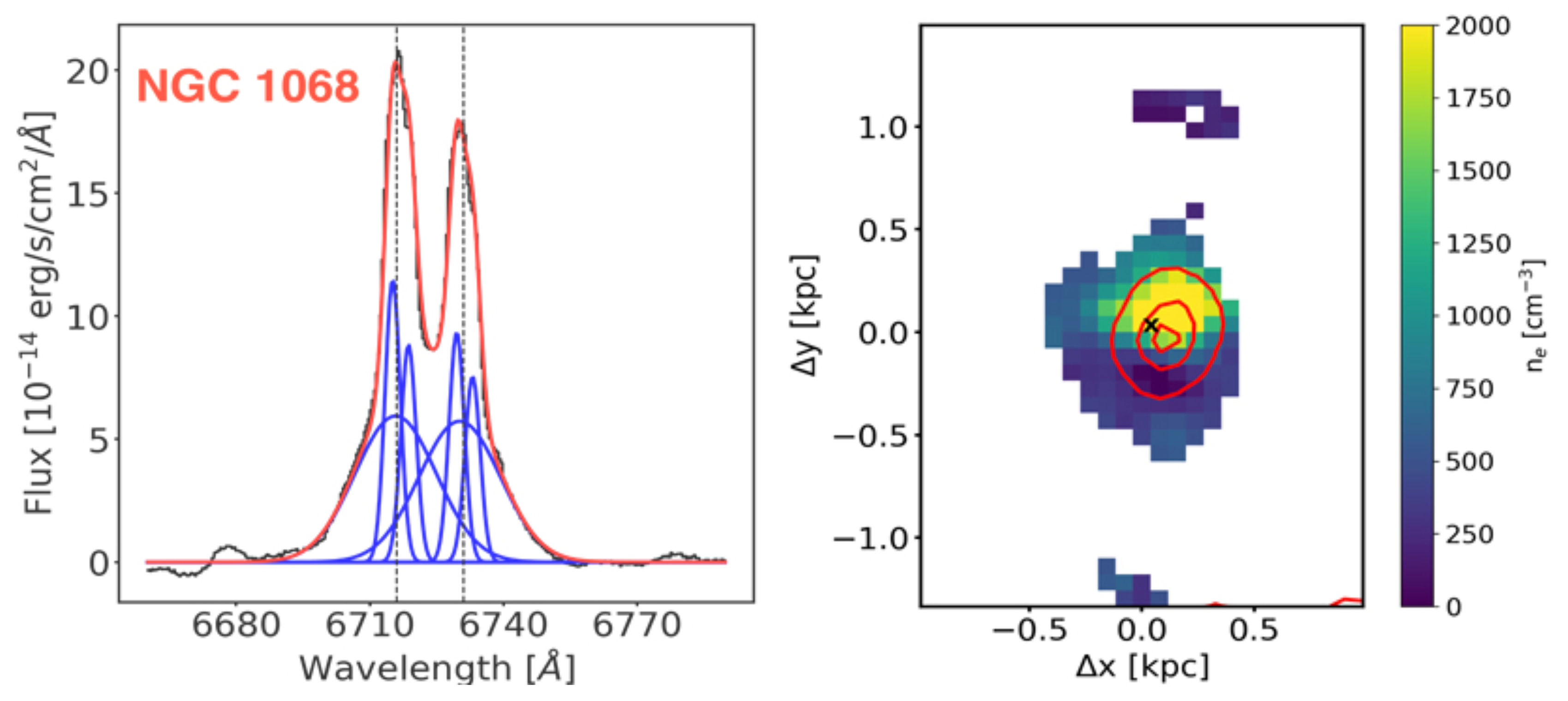
Most massive galaxies host central supermassive black holes that grow via gas accretion from the interstellar medium. Energy released by the AGN, in the form of radiation due to accretion activity or collimated jets, can drive fast outflows with velocities reaching beyond 1000 km s⁻¹, impacting the molecular gas reservoir and eventually regulating star formation. I use IFU spectroscopy to trace these outflows across multiple gas phases and to quantify their spatial extent, energetics, mass outflow rates, and coupling efficiency. For further details, please see Kakkad et al. (2016), Kakkad et al. (2020), Kakkad et al. (2022) and Kakkad et al. (2023).
Spatial extent of outflows
Outflow Scaling relations
Outflow conditions: Electron density
Molecular gas properties of AGN host galaxies
Cold molecular gas is the primary fuel for star formation in galaxies, and any impact of AGN activity or outflows should first be apparent in the molecular gas reservoir. In
Kakkad et al. (2017), we used ALMA CO observations to compare the molecular gas content of a mass-matched sample of AGN host galaxies
and star-forming galaxies at cosmic noon (z=1–3). We found that AGN hosts have systematically lower molecular gas fractions, providing strong evidence for the role of AGN feedback during this epoch.
We are now actively using JWST MIRI-MRS observations from Cycle-1 and Cycle-2 programmes to investigate if the molecular gas is instead heated to warmer temperatures by AGN radiation, commonly observed via ro-vibrational
and rotational transitions in the rest-frame near-infrared and mid-infrared wavelengths. Kakkad et al. (2025) showed the first detection of hot molecular hydrogen in an AGN host galaxy at Cosmic noon, believed
to have been heated by AGN radiation as well as jet-induced shocks.
Watch this space for further updates on JWST results on molecular gas content and composition in AGN host galaxies.
Star formation in AGN host galaxies
Over long timescales, the influence of AGN on their host galaxies should be reflected in their star formation rates. However, measuring star formation and disentangling the impact of AGN activity is non-trivial, as it depends critically on whether a
given diagnostic reliably traces star formation (or AGN activity). Furthermore, the characteristic timescales probed by AGN and star formation indicators vary significantly across different tracers.
In Kakkad et al. (2023), we show how the short timescale tracer, Hα, is contaminated by AGN ionisation and that Hα traces star formation only in 25% of the AGN host galaxies
at Cosmic noon. Where it does trace star formation, the AGN only shows local impact of quenching and not globally across the host galaxy scale.
Hα can also be dust obscured. Polycyclic Aromatric Hydrocarbons (PAHs) offer an alternate way to trace dust-obscured star formation on short timescales (10 Myrs). We are actively working on PAH emission in cosmic noon sources using approved JWST programmes.
Further updates will be posted here soon.
Software development for spectroscopic data analysis
I like developing codes and software for data analysis and visualisation. Below are links of few examples:
- Click here to access a multi-Gaussian fitting code for optical IFU data. The code can be easily adapted for single or a group of spectra.
Please feel free to get in touch with me (see contact details) if you are interested to do a short-term internship, summer project or a PhD project.